DEUS STANISLAUS
CF/CAM
-
 • 9/15/26
TRANSITION = SPRINT.
This video is about getting from point A to point B quicker in transition moments. When you just win the ball, the other team's shape is broken and spread out. They have gaps, and you need to sprint into those gaps before the defenders can close them.
A lot of players coast when the ball is being played out. When you coast, the defender marking you catches up, and by then the space is closing. You end up a step late and have to take a blind side run instead of getting in front of the defender where you wanted to be. Treating transition moments as a race against the closest defender changes everything.
The professionals sprint full-on into these moments because transition moments reward speed. If you don't sprint hard enough, the gaps close and the opportunity is gone. Sprint and trust the ball will find you. That's the difference between being late to the situation and being ahead of your defender in space.
Previous
-
 • 9/10/26
DRIVE.
This video is about turning forward as a 10 and why being direct is one of the biggest strengths you can develop in that position.
We look at what happens when you turn and face the back line, how defenders' priorities immediately change, and why a defender becoming passive gives you more time to attack.
When you commit a defender, you force them to make a decision. If they step, you create space behind them. If they don't step, you continue driving until you're close enough to create or finish. Usually, they just back off…..
The goal is to become more comfortable being the player forcing the decision, rather than releasing the ball early and allowing the opposition to stay comfortable.
Turn forward. Pick one defender. Drive. Make them decide.
-
 • 8/15/26
LOCK TO ONE SIDE.
The key adjustment is learning how to lock the play onto that side instead of allowing the opponent to switch. Once your team has created the numerical advantage, you don't want to give it away by becoming late across the pitch.
The breakdown also looks at your responsibility when you're the one pressing their six, particularly the distance you need to maintain, using the ball's travel time to find your six, and avoiding ball-watching so you can arrive with pressure immediately when she receives.
The next level is simple: know your responsibility before the ball gets there, arrive with the right distance, and keep the press exactly where you want it.
-
 • 7/4/26
run in behind.
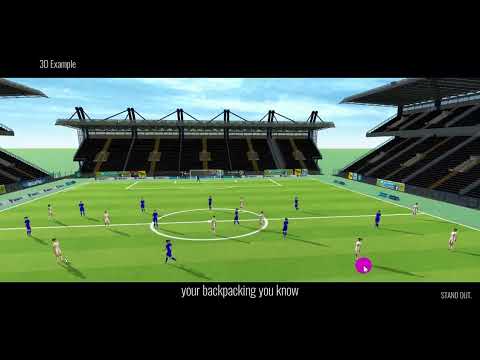
This video is about recognizing where your biggest opportunities come from against a high line.
A lot of forwards focus on their positioning between defenders, but positioning is only the starting point. The real opportunity comes from what happens next.
When defenders are holding a high line and teammates have time to play forward, the space behind the back line becomes one of the most dangerous areas on the pitch. The best strikers consistently attack that space, even when they don't receive the ball every time.
Starting from a backpack position creates the advantage. It prevents defenders from seeing both the ball and the runner in the same frame. From there, the run can attack either side of the defender, including curved runs that finish between the posts.
The goal isn't simply to stay on the blind side.
The goal is to use the blind side to arrive in goalscoring positions.
High line.
Attack the space behind.
Start from the backpack.
Curve across defenders.
Arrive between the posts.
-
 • 5/9/26
CENTRAL THREAT.
This video is about movement in a fluid front two and why somebody always has to stay between the posts.
In fluid systems it’s natural to want to attack the open space that gets created when your strike partner clears wide.
But the most dangerous thing in football is not just open space.
It’s the angle to goal.
If both forwards drift away from the middle, the defensive structure becomes much more aggressive because there is no central threat occupying the best angle to goal.
That’s why one striker clears and one striker stays central.
The important detail is understanding that the open space itself already affects the defense.
Defenders shift toward it.
They become ball-watching.
And that’s where the blind side opens up.
Instead of automatically chasing the obvious space, the better solution is often to fake that movement first and then attack the blind side between the posts with a second movement.
Those small double movements are what create real separation in the box.
The key throughout the video is discipline.
Not every open space is yours to occupy.
Sometimes your job is to stay central, stay dangerous, and become the player attacking the final action between the posts.
-
 • 4/18/26
CLOSE OUTLETS.
This video looks at how you defend when the game becomes unstructured, especially when the ball breaks a line or in transition moments.
In these situations, you’re already doing a good job of recognizing danger and trying to close passing options.
The next step is how you can make it more effective with less movement.
Right now, you tend to pick one option and run across to close it.
But in these moments, you don’t need to choose just one.
Instead, think about the space around the ball.
If you step closer to the ball, you naturally close multiple passing lanes at the same time, just by your position.
So rather than moving away from the ball to close one option, you move toward it and tighten the space around it.
That way, you’re still applying pressure on the ball, while also taking away other options.
This is what strong pressing teams do.
They don’t spread out, they collapse toward the ball and make everything tight.
So the idea is simple.
Stay close to the ball.
Make the space around it small.
Close more than one option at once.That’s how you make these moments easier to control.
-
 • 4/27/26
4-4-2.
This video breaks down a key shift in your role when playing in a 4-4-2.
The key is working with your striker partner and recognizing when to attack space.
The trigger is clear:
when the player on the ball has time and the back line is high,
you don’t come short…
you run in behind, especially into the channels.Right now, there’s a habit of dropping to feet in these moments,
even when there is space to attack.And that’s costing you.
Because in a 4-4-2, the wide channels are often open,
and if you don’t attack them, nobody will.But this is not just about your run.
It’s about the relationship with your partner:
one clears space, one occupies between the posts.
If both of you go wide, there is no presence in the most dangerous area.
If one runs the channel, the other must stay central.The detail that ties it together is simple:
ball side.
If the ball is on your side → you clear and run the channel.
If the ball is on the opposite side → you stay central.That’s how you create space for each other
and keep a constant threat between the posts.Recognize the trigger.
Attack the channel.
Coordinate with your partner.That’s what turns movement into goals.
-
 • 5/6/26
CURVED RUN.
This video builds on something you’re already doing really well.
You recognize the moment when the line is broken, you play the pass, and you immediately continue your run into the gap. That part is very good, and it shows you understand the pattern.
The next step is a small detail that will help you get even more out of these situations.
It’s not just about entering the gap.
It’s about how you arrive into it.Right now, your run tends to curve slightly away from goal.
That still makes you available, but it means that if you receive, your momentum is taking you away from the most dangerous area.So instead of being able to attack immediately, you need an extra touch, and that gives defenders time to recover.
The adjustment is simple.
Shape your run so you arrive toward goal.
Same movement.
Same timing.
Just a different curve at the end.Now when you receive, your momentum works in your favor, and you can move forward in one action, ideally between the posts.
This is especially important when you run behind fullbacks.
The space is naturally wide, but how you enter it determines how dangerous you can be after.
So the key idea is:
don’t just find the space — arrive in it with the right direction.You’re already doing the hard part.
This just helps you turn those moments into clearer chances.