
When I watch you play, the biggest thing holding you back isn’t your technique or your athleticism — it’s the moment the ball is travelling to you.
That’s the moment where your picture goes incomplete, and for a CDM, that moment decides everything.
You actually scan well before the ball arrives.
You see your teammates.
You see the space.
You see the options.
That part of your game is already strong.
But when the ball is on its way to you, your scanning stops.
And that’s exactly when the most important scan needs to happen — the critical scan.
This scan is simple:
as the ball travels, you identify the pressure.
Not the space.
Not the options.
Not the teammates.
Just the immediate threat.
Because if you don’t see the pressure early, you don’t know your space.
You don’t know if you can turn.
You don’t know how far you can turn.
You don’t know whether the next action should be progression or protection.
That’s why you take extra touches.
That’s why the tempo slows.
That’s why defenders recover on you.
And at the international level, that kills progression.
The rhythm you need is this:
ball–pressure, ball–pressure, ball–pressure.
When this becomes instinct, your first touch becomes direction, not survival.
You start breaking pressure before it arrives.
You start controlling the rhythm instead of reacting to it.
This is the habit that will change your entire ceiling as a CDM.

One of the biggest upgrades you can make in your positioning is understanding lines — and this is something that fits your game perfectly once you commit to it.
As a CDM, the “line” is the closest player responsible for marking you — usually the striker.
And in your clips, I see moments where you stay too close to that line, which means you receive the ball in pressure instead of behind pressure.
Here’s the shift you need to make:
When your team has control and a numerical advantage, you position yourself beyond that line.
This removes the striker from the play before the ball even arrives.
You’re no longer receiving the ball with someone on your back — you’re receiving it with the whole pitch in front of you.
This changes everything.
Your body shape opens.
Your first touch becomes forward.
Your passing angles multiply.
Your tempo becomes cleaner.
And the opponent’s entire block has to adjust to you.
Positioning beyond the line is how elite CDMs stay one step ahead.
It’s how they break pressure early.
It’s how they control the rhythm.
It’s how they make progression feel effortless.
When you start thinking in lines, you stop playing inside the opponent’s structure and start playing above it — and that’s where your potential really lives.
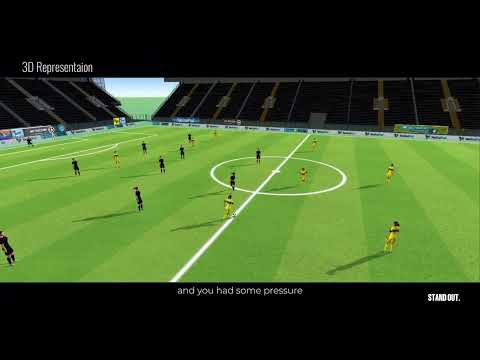
There’s a part of your game that’s sitting right there waiting to be unlocked — and it fits your profile perfectly: drive across zones.
You don’t need to dribble like a winger.
You don’t need to beat players for show.
But you do need to understand how much control you gain when you drive sideways.
The pitch is built in zones.
Defenders operate in a mix of man‑marking and zonal responsibility.
And when you move laterally across those zones, you force defenders into decisions they don’t want to make.
Do they follow you and leave their zone open?
Or do they hold their zone and leave your teammate free?
This is where you can be so much more dangerous.
Because here’s the truth:
handovers are never clean.
When one defender passes you to the next, there’s always a hesitation.
A delay.
A moment where neither player fully commits.
And that moment is your window to play forward.
Sideways dribbling isn’t about flair for you.
It’s about manipulation.
It’s about forcing the opponent to react to your movement instead of you reacting to theirs.
It’s about creating separation without needing to beat anyone.
When you add this to your game, you stop waiting for space to appear — you create it.
And that’s what elevates you from tidy to influential.