ZACH ZOELLHER-KRAUSS
THE FRAMEWORK.
The concepts behind your videos, all in one place.

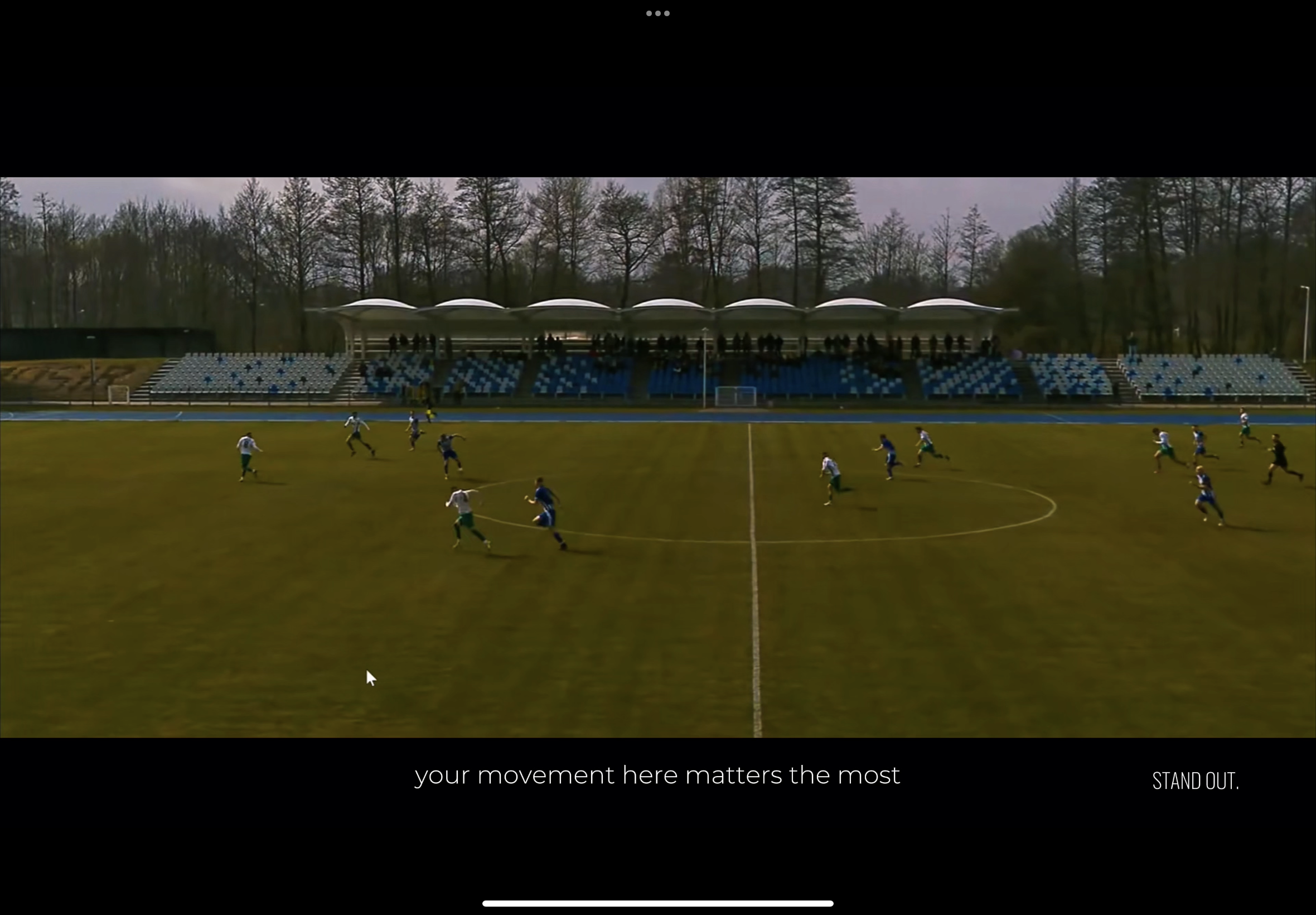
This video is about pressing with purpose.
A good press is not just about working hard or covering ground.
It's about taking away time and narrowing options.
When outside center backs receive the ball, they often have the best angle to play channel balls behind the defensive line. If they have time, they can lift their head, assess the picture, and pick out those passes.
The key is recognizing the trigger early.
As the ball travels to the outside center back, the press should already be moving.
Use the time the ball is traveling to arrive on the far shoulder and make the field smaller.
The goal is not always to win the ball immediately.
The goal is to make the next action more difficult.
A smaller field means fewer options.
Fewer options means more predictable play.
And more predictable play makes the next phase easier for your team to win.
Recognize the trigger.
Press the far shoulder.
Make the field smaller.
Control the next phase.

This video is about how your positioning between the lines changes the entire play as a number 10.
There are two different pockets you can receive in between the midfield line and the back line:
the low pocket closer to midfield, and the high pocket closer to the center backs.
And which pocket you occupy determines which line becomes responsible for pressing you.
When you receive in the low pocket, the midfielder usually has to step to you instead of the center back.
That gives you more time to turn, face forward, and drive at the back line.
The reason is simple:
center backs do not want to sprint aggressively that far into midfield because once they commit their momentum forward, they become vulnerable to quick combinations, directional touches, and getting played around.
That’s why the low pocket is such a cheat code for chance creation.
The biggest detail in the video is the moment between the pass and your first touch.
Once you’ve eliminated the midfield line, you do not want to invite that pressure back into the play.
The goal is to follow the ball trajectory, receive in one continuous movement, and immediately cut the midfielder off with your body and first touch.
No stop-start football.
One fluid action.
This is where top attacking midfielders create time, separation, and chances facing forward.

This video breaks down what actually matters when the line breaks in the final third.
At higher levels, it’s not about keeping the ball or playing wide.
It’s about recognizing the moment when the back line breaks and attacking the space behind it immediately.
When a center back steps, the line splits.
The rest of the defense has to rebuild.
That reaction is often late because players become ball-watching.
That’s where the opportunity is.
The gap is not seeing it…
it’s reacting to it early enough.
Right now, there’s a delay.
Following the ball instead of attacking the space.
Which forces other players to fill your role and kills the attacking structure.
The detail is in two things:
What you look at.
Shift from the ball to the space behind the line the moment it breaks.
How you position.
Avoid straight-line pressure.
Create angles so you can turn and play forward.
And even when you don’t receive…
the moment still belongs to you.
When the line breaks, the game becomes unstable.
That’s your cue to run straight, vertical, toward goal and arrive in the most dangerous space.
Recognize the line break.
Attack the gap immediately.
Position to play forward.
Arrive in the second action.
That’s what turns these moments…
into real output.